Why Automate Playlist Management for DJs
Switching between Spotify, Apple Music, and SoundCloud often means hours spent re-sorting playlists and losing track continuity. DJs and music curators know the struggle when seamless migration across platforms is key for live shows and long-term organization. With automated playlist management, smart recommendation tools powered by machine learning make it easier to build custom sets, discover new tracks, and maintain your musical structure. This guide breaks down how to protect your collection’s integrity while taking full advantage of automation.
Table of Contents
- What Automated Playlist Management Means
- Types of Playlist Automation Solutions
- How Automation Improves DJ Workflow
- Risks, Limitations, and Data Security Concerns
- Comparing Manual vs. Automated Playlist Management
Key Takeaways
| Point | Details |
|---|---|
| Automated Playlist Management | Uses advanced algorithms to create and optimize music playlists, enhancing music discovery and reducing manual effort. |
| Types of Solutions | Automation includes manual, automatic, and assisted creation, each catering to different user needs and preferences. |
| DJ Workflow Automation | Enhances performance preparation and live mixing through automated tasks like beatmatching and track transitions, allowing DJs to focus on creativity. |
| Privacy and Security Risks | Automated systems raise data security concerns, necessitating strong protective measures to safeguard user information and preferences. |
What Automated Playlist Management Means
Automated playlist management represents a sophisticated technological approach that transforms how DJs and music enthusiasts organize and curate their digital music collections. At its core, it utilizes advanced computational algorithms to streamline playlist creation and optimization, reducing manual effort while enhancing music discovery.
The fundamental concept involves using machine learning algorithms to intelligently manage music libraries. Computational recommendation systems analyze user preferences, track characteristics, and listening patterns to generate personalized playlists dynamically. These systems go beyond simple song shuffling, actively adapting to a user's evolving musical taste and contextual listening environment.
Key features of automated playlist management include:
- Smart track recommendation based on musical attributes
- Seamless playlist generation without manual song selection
- Adaptive playlist evolution matching user preferences
- Reduction of time spent manually organizing music
- Enhanced music exploration and discovery
Unlike traditional playlist creation, automated management leverages interactive tools that transform the music curation process. These systems encourage musical exploration by suggesting tracks users might not have discovered independently, effectively expanding their sonic horizons while maintaining a cohesive listening experience.
Pro tip: Experiment with automated playlist management tools to discover unexpected musical connections and broaden your genre exploration.
Types of Playlist Automation Solutions
Playlist automation solutions have evolved to provide DJs and music enthusiasts with sophisticated methods for managing their digital music collections. Playlist automation techniques can be broadly categorized into three primary approaches: manual creation, automatic generation, and assisted playlist development.
The main types of playlist automation solutions include:
- Manual Creation: Traditional method where users personally select and organize tracks
- Automatic Generation: Algorithmic playlist creation without direct human intervention
- Assisted Creation: Collaborative approach combining user input and algorithmic recommendations
Automatic generation represents the most advanced form of playlist management. Playlist recommendation techniques leverage complex algorithms to analyze musical attributes, user preferences, and listening patterns. These sophisticated systems employ various methodologies such as:
- Collaborative filtering
- Content-based filtering
- Popularity-based recommendations
- Sequence-aware models
- Context-aware algorithms
Each automation approach offers unique benefits for DJs and music curators. Collaborative filtering examines user behavior across large datasets, while content-based filtering focuses on musical characteristics like genre, tempo, and mood. Hybrid systems combine multiple techniques to create more nuanced and personalized playlist experiences.
Here is a comparison of playlist automation approaches and their ideal use cases:
| Approach | Best For | Typical User | Scalability |
|---|---|---|---|
| Manual Creation | Personal touch and customization | DJs valuing artistic control | Limited, best for small collections |
| Automatic Generation | Fast processing and large libraries | DJs needing efficiency | High, handles vast catalogs easily |
| Assisted Creation | Blend of input and discovery | DJs wanting recommendations with control | Moderate, adaptable to preferences |
Pro tip: Experiment with different playlist automation solutions to find the approach that best matches your musical curation style and audience preferences.
How Automation Improves DJ Workflow
DJ workflow automation represents a transformative approach to music performance and preparation, dramatically reducing technical barriers and freeing creative potential. Advanced DJ workflow techniques enable musicians to focus more on artistic expression and audience interaction by handling complex technical tasks automatically.
Key improvements in DJ workflow through automation include:
- Automatic beatmatching and phase alignment
- Real-time key detection
- Seamless track transition analysis
- Intelligent cue point selection
- Harmonic mixing recommendations
Technical automation dramatically streamlines performance preparation. Generative audio techniques now support complex mixing processes, enabling DJs to create more sophisticated and nuanced performances with less manual intervention. These advanced systems can replicate human mixing styles while reducing the cognitive load of technical mixing requirements.
The most significant workflow enhancements occur in three primary areas: pre-performance preparation, live mixing, and post-performance analysis. Automation tools now provide intelligent recommendations, track compatibility assessments, and seamless transition suggestions that were previously impossible without extensive manual research and practice.
To illustrate how workflow automation affects DJ performance stages, see this summary:
| Stage | Automation Benefit | Creative Outcome |
|---|---|---|
| Preparation | Automated track sorting and cue points | More time for creative planning |
| Live Mixing | Instant beat and key matching | Smoother transitions and audience engagement |
| Post-Performance | Automated playlist analysis | Improved future set design |
Pro tip: Invest time in understanding your automation tools' capabilities to maximize their potential and develop a unique performance style.
Risks, Limitations, and Data Security Concerns
Automated playlist management introduces complex privacy and security challenges that DJs and music enthusiasts must carefully navigate. Data protection concerns have become increasingly critical as these systems collect and process increasingly sensitive user information.
Key data security risks include:
- Unauthorized personal data access
- Potential regulatory non-compliance
- Risk of data breaches
- Exposure of listening preferences
- Vulnerabilities in AI recommendation systems
Privacy vulnerabilities emerge through multiple technological channels. AI-based playlist automation amplifies potential risks through large-scale data collection, creating opportunities for inference attacks and model manipulation. These systems can potentially expose users' musical tastes, behavioral patterns, and personal preferences without robust security measures.
Mitigating these risks requires a comprehensive approach involving encryption, transparent data governance, user consent mechanisms, and adherence to international privacy regulations. DJs and music platforms must implement stringent security protocols that protect user data while maintaining the sophisticated functionality of automated playlist systems.
Pro tip: Always review privacy settings and understand how your playlist management tools handle and protect your personal data.
Comparing Manual vs. Automated Playlist Management
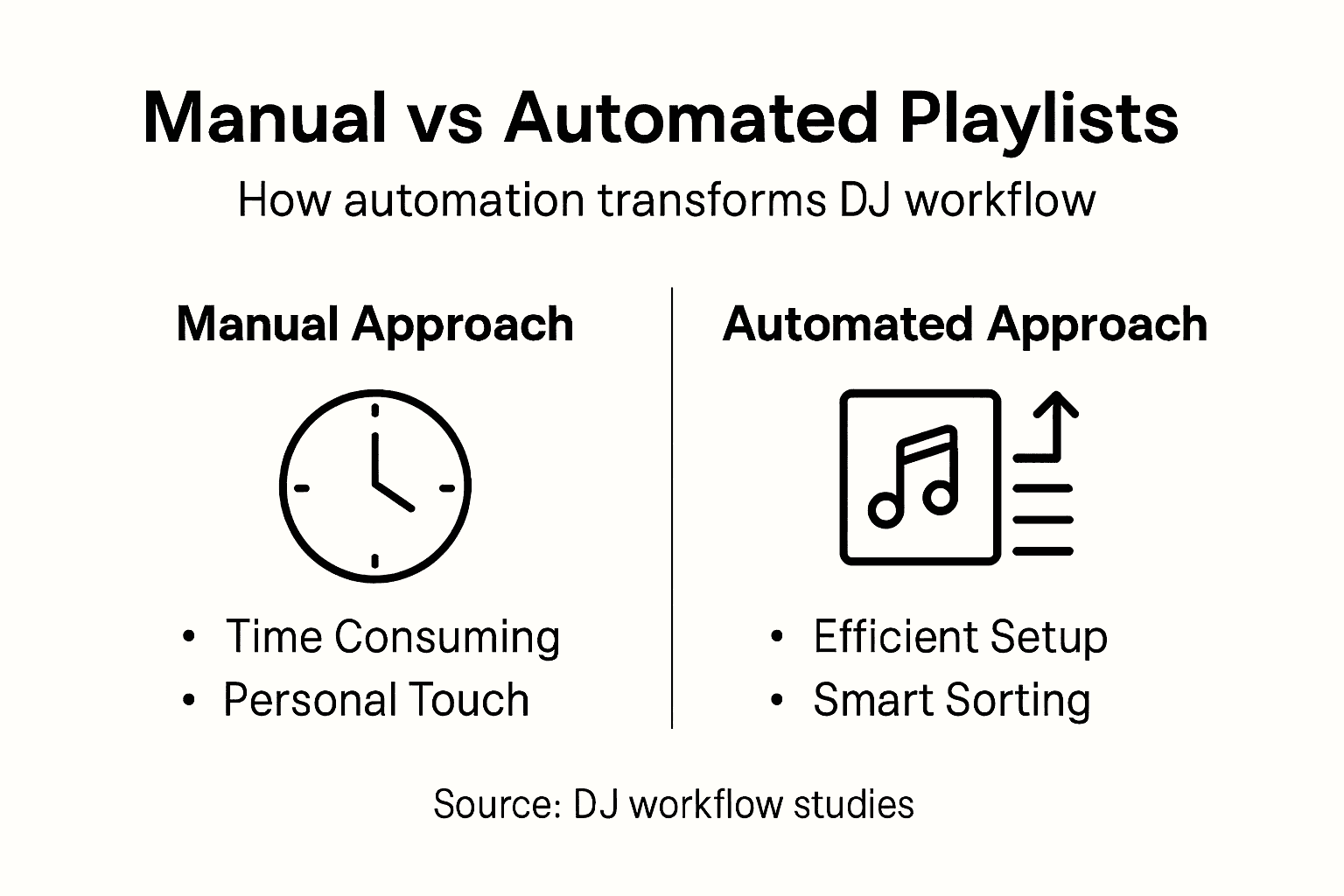
Playlist management approaches vary significantly between manual and automated methods, each offering unique advantages and challenges for DJs and music enthusiasts. Manual playlist creation provides unparalleled creative control, allowing musicians to craft intricate musical journeys that reflect their personal artistic vision.
Key differences between manual and automated playlist management include:
- Creative control and personal touch
- Time investment required
- Scalability of music collection
- Complexity of track selection
- Potential for musical discovery
- Emotional nuance in curation
Automated systems transform playlist creation by leveraging advanced algorithms. Comparative playlist studies reveal that automated tools increase user engagement and music exploration, though they sometimes introduce additional complexity in the decision-making process. These systems excel at managing large music catalogs, reducing cognitive load, and suggesting unexpected musical connections that manual curation might overlook.
Hybrid approaches represent the most promising solution, combining the emotional intelligence of manual curation with the efficiency and scalability of algorithmic recommendations. By blending human creativity with technological precision, DJs can create more dynamic, personalized, and expansive musical experiences that adapt to changing audience preferences.
Pro tip: Experiment with both manual and automated playlist management techniques to develop a unique approach that maximizes your creative potential.
Simplify Your Playlist Management and Enhance Your DJ Workflow
Managing playlists manually or navigating complex automation can often create bottlenecks for DJs who want to focus on creativity and delivering engaging performances. This article highlights how automated playlist management elevates efficiency but also reveals challenges like maintaining playlist structure and handling multiple streaming platforms. You want a reliable solution that preserves your carefully curated music while seamlessly syncing across services without losing hours restarting from scratch.
FreeYourMusic.com is built precisely for DJs and music enthusiasts facing these challenges. Our specialized SaaS platform automates the migration and synchronization of unlimited playlists across Spotify, Apple Music, Tidal, YouTube Music, Amazon Music, and more. With options for cloud backup, accurate song matching, and multi-account support, you can maintain your distinctive playlist flow effortlessly while adapting to evolving streaming platforms. This means less time managing tech hassles and more time optimizing your set and exploring creative possibilities.
Discover how easy it is to transfer and synchronize your music collections today.
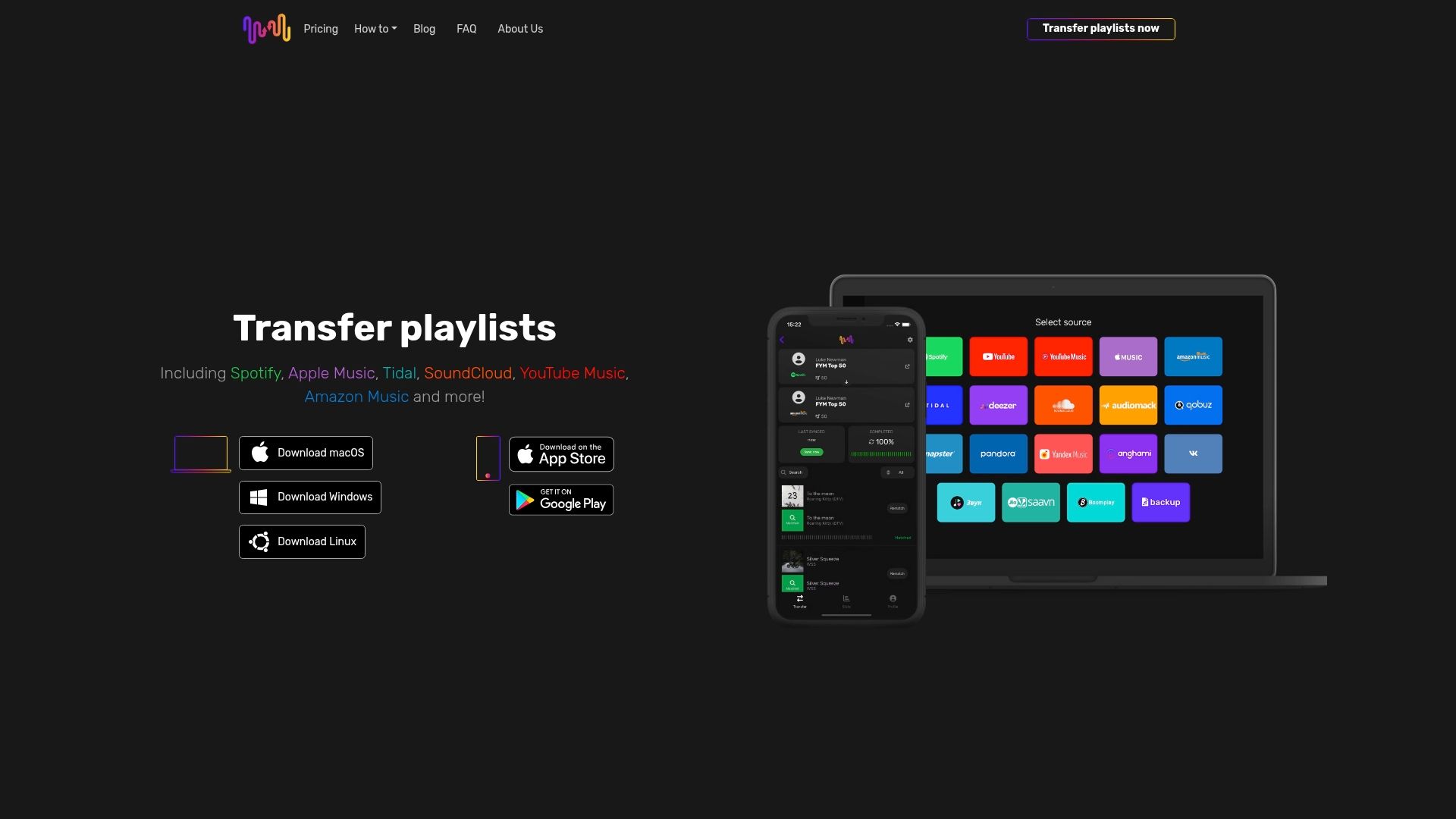
Ready to transform your automated playlist management and take full control of your music workflow? Visit FreeYourMusic.com now and streamline your playlist transfers with confidence, security, and ease.
Frequently Asked Questions
What is automated playlist management?
Automated playlist management is a technology-driven approach that uses machine learning algorithms to organize and curate digital music collections, enabling DJs and music enthusiasts to streamline playlist creation, enhance music discovery, and reduce manual effort.
How does automation improve a DJ's workflow?
Automation improves a DJ's workflow by handling complex technical tasks, such as beatmatching, key detection, and track transitions, allowing DJs to focus more on creativity and audience engagement during live performances.
What are the different types of playlist automation solutions?
The main types of playlist automation solutions include manual creation, automatic generation, and assisted creation. Each approach has specific benefits, with automatic generation being the most advanced, requiring little to no human intervention.
What are the risks associated with automated playlist management?
The risks include unauthorized access to personal data, potential data breaches, and privacy vulnerabilities. It is crucial for DJs and users to implement strong security measures and understand how their data is handled.
Recommended
Your playlists belong to you.
Stop rebuilding by hand. Move everything in minutes and take your music wherever you go.
Download free →SongsBrew — our free music newsletter
A free perk for FYM users. Tips, playlists, no spam.