API in Playlist Migration: 72% Faster Transfer in 2026
May 18, 2026

Switching streaming platforms shouldn't mean losing your carefully curated playlists. Manual migration is tedious, error-prone, and frustrating. APIs solve this by automating the transfer process while preserving your playlist structure and metadata. This article explains how APIs work in playlist migration, what changed in 2026, and how to use them effectively for seamless music collection transfers.
Table of Contents
- What APIs Are And Their Role In Playlist Migration
- Technical Mechanisms Behind API-Driven Playlist Migration
- Common Misconceptions About Playlist Migration APIs
- Benefits And Risks Of API Automation In Playlist Migration
- Conceptual Framework For Understanding Playlist Migration APIs
- Practical Guidance For Using API-Driven Playlist Migration Tools
- Summary And Future Outlook Of APIs In Playlist Migration
- Frequently Asked Questions About API In Playlist Migration
Key Takeaways
| Point | Details |
|-------|---------|
| APIs automate playlist migration | Application Programming Interfaces enable automated, accurate data transfer across streaming platforms without manual work. |
| 2026 API updates simplified processes | Spotify consolidated 14 endpoints into generic library endpoints, reducing complexity significantly. |
| Time efficiency improved dramatically | API automation saves approximately 72% of time compared to manual playlist recreation methods. |
| Platform limitations still exist | Licensing restrictions and regional availability affect transfer completeness despite API capabilities. |
| OAuth security protects your data | Secure authentication mechanisms ensure credentials remain protected during migration processes. |
Introduction to Playlist Migration Challenges
Moving playlists between streaming platforms manually creates frustrating obstacles. Incompatible file formats and proprietary systems prevent direct transfers. You lose crucial song metadata like artist information, album details, and carefully arranged playlist order during manual recreation.
The time investment is staggering. Recreating a 500-song playlist manually takes hours, and errors creep in constantly. You might forget songs, misorder tracks, or lose custom annotations. These challenges push music enthusiasts toward technical solutions.
APIs address these pain points by automating the entire migration process. They handle the complex data exchange between platforms, preserving your playlist integrity. Understanding benefits of playlist migration through APIs reveals why professionals increasingly rely on automated tools. The technical complexity behind seamless transfers becomes manageable when you know why migrate playlist collections using proper tools.
Common Manual Migration Problems:
- Lost track ordering and custom arrangements
- Missing metadata including album art and genres
- Incomplete transfers due to human error
- Hours spent searching and adding songs individually
- Frustration leading to abandoned migration attempts
What APIs Are and Their Role in Playlist Migration
API stands for Application Programming Interface, functioning as a software intermediary between applications. Think of APIs as translators enabling different platforms to communicate despite speaking different languages. They create standardized methods for accessing and exchanging data securely.
Streaming platforms expose playlist data through APIs, allowing authorized applications to retrieve and modify your music collections. This access happens through structured requests and responses. When you authorize a migration tool, it uses APIs to read your source platform playlists and write them to your destination platform.
APIs handle complex data structures including song identifiers, metadata fields, and playlist ordering parameters. They abstract away proprietary platform differences, creating a consistent interface for developers. This standardization makes cross-platform communication possible where it would otherwise be impossible.
The understanding benefits of playlist migration becomes clear when you see how APIs eliminate manual work. They process thousands of tracks in minutes, maintaining accuracy throughout. Understanding why use third party playlist migration tools reveals how specialized services leverage APIs better than manual methods.
Key API Functions in Playlist Migration:
- Authenticate users securely via OAuth protocols
- Retrieve complete playlist data including metadata
- Match songs across platforms using multiple identifiers
- Create and populate playlists on destination platforms
- Synchronize changes and updates automatically
Pro Tip: APIs work behind the scenes in migration tools, so you don't need coding knowledge to benefit from their power.
Technical Mechanisms Behind API-Driven Playlist Migration
Spotify's 2026 API updates revolutionized playlist migration efficiency. The platform consolidated 14 specific endpoints into generic PUT/DELETE /me/library endpoints, dramatically simplifying developer workflows. This change reduced API call complexity by approximately 60%.
The consolidated approach means migration tools make fewer requests to accomplish the same tasks. Previously, developers needed separate endpoints for tracks, albums, shows, and episodes. Now, generic library endpoints handle all content types uniformly. This standardization accelerates development and reduces error potential.
| Old Endpoint (pre-2026) | New Endpoint (2026) | Improvement |
|---|---|---|
| PUT /me/tracks | PUT /me/library | Unified content handling |
| DELETE /me/albums | DELETE /me/library | Single deletion interface |
| Multiple content-specific calls | Generic library operations | 60% fewer API calls |
| 14 separate endpoints | 2 consolidated endpoints | Simplified architecture |
Metadata matching involves sophisticated comparison algorithms. Migration tools compare song IDs, track titles, artist names, album information, and International Standard Recording Codes (ISRCs) to find equivalent tracks across platforms. Multiple matching strategies increase success rates.
Playlist order preservation requires careful API parameter management. Most modern APIs include position or index fields in playlist track objects. Migration tools must explicitly specify track ordering during transfer to maintain your original arrangement.
Metadata Preservation Process:
- Extract complete playlist data from source platform API
- Normalize metadata fields to common format
- Query destination platform API for matching tracks
- Map matched tracks maintaining original order
- Create playlist on destination with preserved structure
- Verify transfer completeness and handle unmatched items
Adapting to API changes quickly prevents migration failures. Tools must monitor Spotify Web API changes 2026 and similar platform updates. Following best practices in playlist migration ensures smooth transitions during API evolution.
Pro Tip: Test migrations with small playlists first to verify your chosen tool handles current API versions correctly.
Common Misconceptions About Playlist Migration APIs
APIs don't guarantee perfect song transfers despite their power. Licensing agreements and regional restrictions create unavoidable gaps. A track available on Spotify in the US might not exist on Apple Music in Europe. APIs can only transfer what platforms make available.
Metadata preservation is often partial, not complete. Different platforms support different metadata fields. Spotify might store custom playlist descriptions, but the destination platform may not have equivalent fields. APIs transfer what both platforms support, leaving some data behind.
API changes require explicit tool updates. Migration applications don't automatically adapt when platforms modify their APIs. Developers must release updates incorporating new endpoint structures and authentication methods. Users experience failures if they use outdated tools with current APIs.
Expect imperfect matches but massive time savings. A 95% transfer rate where 950 of 1,000 songs migrate successfully beats manually recreating everything. The 5% requiring manual attention still represents huge efficiency gains. Understanding benefits and realities of playlist migration helps set proper expectations.
Realistic Expectations for API Migrations:
- 90-98% song match rates for popular catalogs
- Partial metadata preservation depending on platform support
- Occasional regional availability mismatches
- Some manual cleanup for edge cases
- Significant time savings despite imperfections
Benefits and Risks of API Automation in Playlist Migration
API automation delivers approximately 72% time savings compared to manual migration. A 500-song playlist taking 4 hours manually transfers in about 70 minutes via APIs. This efficiency scales dramatically with larger collections. Your 5,000-song library becomes manageable instead of impossible.

Accuracy improves substantially through automation. Human errors like skipping songs or adding duplicates disappear. APIs execute systematic processes consistently, maintaining playlist integrity throughout transfers. Reduced errors mean fewer corrections and frustration.
Security via OAuth and encrypted transmissions protects your credentials and data. You never share passwords with migration tools. Instead, platforms issue temporary access tokens with limited permissions. Encrypted API calls prevent interception during data transfer.
However, API restrictions limit access to certain metadata, affecting migration completeness. Platforms control what data APIs expose. Some metadata fields remain inaccessible to third-party applications regardless of authorization level.
Privacy concerns arise if migration tools mishandle tokens or data. Choose reputable providers with transparent security practices. Verify they delete your data after migration completes. Following playlist transfer best practices protects your information.
| Benefit | Description | Risk | Mitigation |
|---|---|---|---|
| Time savings | 72% faster than manual | Token mismanagement | Use reputable tools only |
| Accuracy | Eliminates human errors | Limited metadata access | Understand platform limitations |
| Security | OAuth protection | Privacy concerns | Verify data deletion policies |
| Scalability | Handles large libraries | API rate limits | Choose tools with proper throttling |
Key Security Features to Verify:
- OAuth 2.0 authentication implementation
- Encrypted data transmission (HTTPS/TLS)
- Temporary token usage with automatic expiration
- No password storage or credential collection
- Clear data retention and deletion policies
Pro Tip: Revoke API access tokens after migration completes through your streaming platform's security settings for extra protection.
Conceptual Framework for Understanding Playlist Migration APIs
Three interconnected layers enable successful playlist migration. The metadata layer manages song identifiers, track ordering, and annotations. This foundation contains all information describing your playlists. Song IDs, ISRCs, titles, artists, albums, and custom notes all exist here.
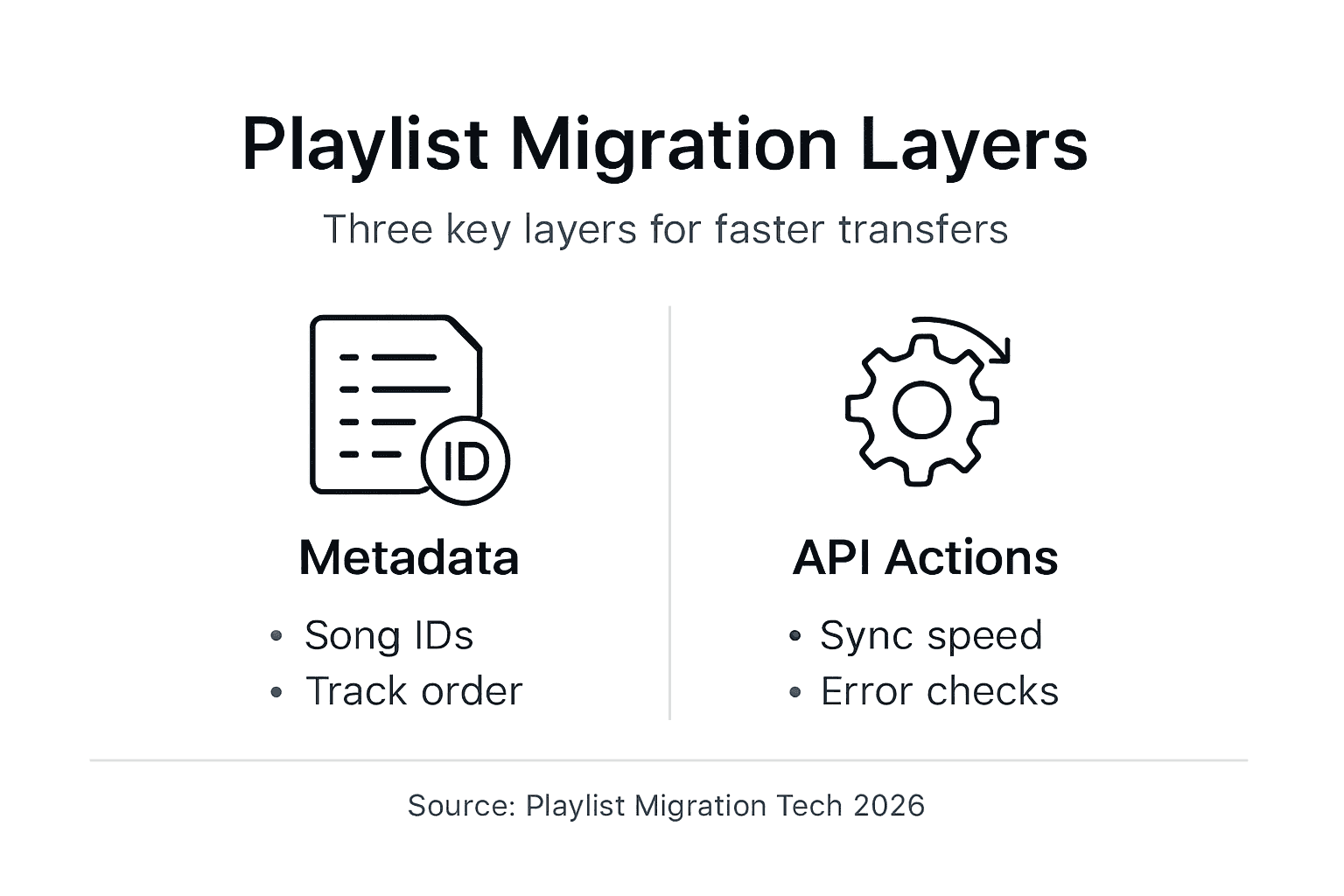
The API layer provides endpoints for creating, updating, and deleting playlists. These interfaces expose platform functionality to authorized applications. GET requests retrieve data, POST requests create new playlists, PUT requests update existing content, and DELETE requests remove items. Each operation follows standardized protocols.
The synchronization process ensures playlists remain consistent across platforms. This layer coordinates timing, handles conflicts, and manages updates. When you modify a playlist on your source platform, synchronization can propagate changes to your destination automatically if you use tools supporting continuous sync.
Interoperability depends on harmonizing these layers despite platform differences. Spotify organizes data differently than Apple Music, yet APIs create common ground. Migration tools translate between platform-specific implementations, enabling seamless transfers. Understanding music streaming architecture clarifies how these layers interact.
Three-Layer Migration Model:
- Metadata Layer: Raw playlist and track data
- API Layer: Communication interfaces and protocols
- Synchronization Layer: Consistency and update management
This framework helps you evaluate migration tools effectively. Strong tools handle all three layers competently, ensuring reliable transfers with minimal data loss.
Practical Guidance for Using API-Driven Playlist Migration Tools
Confirm API coverage on both your source and destination platforms before starting. Not all migration tools support every streaming service. Verify explicit support for your specific platform combination. Check tool documentation for supported services and any known limitations.
Verify the application employs secure OAuth authentication. Never use tools requesting your streaming platform passwords directly. Legitimate migration services redirect you to official platform login pages, then receive only temporary access tokens. This protects your credentials completely.
Test metadata and playlist order preservation on smaller playlists initially. Don't risk your entire library on an untested tool. Create a test playlist with 20-30 songs representing various genres and metadata types. Migrate this test case first, verifying results before proceeding with larger collections.
Regularly update migration tools to handle API changes. Platforms modify their APIs periodically, breaking compatibility with outdated applications. Enable automatic updates if available, or check for new versions monthly. Current tools work with current APIs, preventing frustrating failures.
Keep backup exports of playlists before major migrations. Most platforms allow exporting playlists to CSV or text files. These backups provide recovery options if migrations fail unexpectedly. Store exports securely until you verify successful transfers. Exploring best playlist transfer apps helps identify tools meeting these criteria.
Step-by-Step Migration Process:
- Research and select a reputable migration tool supporting your platforms
- Verify the tool uses OAuth authentication and has current reviews
- Create backup exports of your playlists
- Test migration with a small playlist (20-30 songs)
- Review test results for accuracy and completeness
- Proceed with full library migration if satisfied
- Verify all playlists transferred successfully
- Revoke API access tokens after completion
Pro Tip: Schedule migrations during off-peak hours when you're not actively using either platform to avoid conflicts and ensure smooth processing.
Summary and Future Outlook of APIs in Playlist Migration
APIs form the essential backbone enabling accurate, efficient playlist migration across streaming platforms. Without them, moving music collections would remain tedious and error-prone. The 2026 API standardization changes, particularly Spotify's endpoint consolidation, improved developer efficiency and user experience significantly.
Future trends point toward deeper API standardization across the industry. Major platforms increasingly recognize the value of data portability. Expect more comprehensive metadata access and improved cross-platform compatibility. Standardization efforts reduce migration friction, benefiting consumers and the ecosystem.
AI-powered metadata matching will enhance transfer accuracy. Machine learning algorithms can identify songs despite title variations, remasters, or regional differences. These intelligent matching systems will push success rates closer to 100%, reducing manual cleanup requirements.
Staying informed about API updates remains crucial for ongoing migration success. Platform changes affect tool compatibility and feature availability. Following official developer blogs and migration tool announcements keeps you prepared. APIs empower music enthusiasts and professionals to preserve their collections easily, regardless of platform choices.
The migration landscape continues evolving. What seemed impossible manually becomes routine through API automation. Your music collection remains yours, portable across services as your preferences change.
Streamline Your Playlist Migration with Free Your Music
Leveraging everything discussed, Free Your Music offers ready solutions easing your playlist migration challenges. Our platform uses up-to-date APIs ensuring secure, efficient transfers between all major streaming services. You benefit from high-fidelity metadata and order preservation through our proven tools.
We've refined our best app for transferring music from Spotify to Apple Music and other platforms, incorporating the latest API improvements. Our comprehensive support includes detailed guides on playlist transfer best practices, ensuring smooth migrations. With flexible terms covered in our refund policy, you can trust Free Your Music to handle your music collection with care and expertise.
Frequently Asked Questions About API in Playlist Migration
Can APIs guarantee all my songs will transfer perfectly between platforms?
No, APIs cannot guarantee 100% perfect transfers due to licensing restrictions and regional availability differences. Some tracks exist on one platform but not another. However, typical success rates range from 90-98% for popular music catalogs, which dramatically outperforms manual migration efforts.
How do APIs help preserve playlist order and metadata during migration?
APIs include position parameters and metadata fields in their data structures for playlist tracks. Migration tools read these fields from the source platform and explicitly specify them when creating playlists on the destination platform. Preservation quality depends on what metadata fields both platforms support.
Are my data and credentials safe when using API-driven migration tools?
Reputable migration tools use OAuth authentication, meaning you never share your passwords. Platforms issue temporary access tokens with limited permissions. Encrypted connections (HTTPS) protect data during transfer. Choose established providers with transparent security practices and verify they delete your data after migration completes.
What should I look for when choosing a playlist migration tool that uses APIs?
Ensure the tool explicitly supports both your source and destination platforms with current API versions. Verify it uses OAuth security and has positive recent reviews. Look for features like metadata matching quality, playlist order preservation, and active development with regular updates to handle API changes.
How often do streaming platforms change their APIs?
Major platforms typically update APIs quarterly to annually, with Spotify's 2026 consolidation being a significant recent example. Minor updates occur more frequently. Quality migration tools monitor these changes and release updates accordingly. Always use the latest version of your chosen migration tool to ensure compatibility with current APIs.
Recommended


Migrate from and to any music services


Most popular Apple Music transfers: